
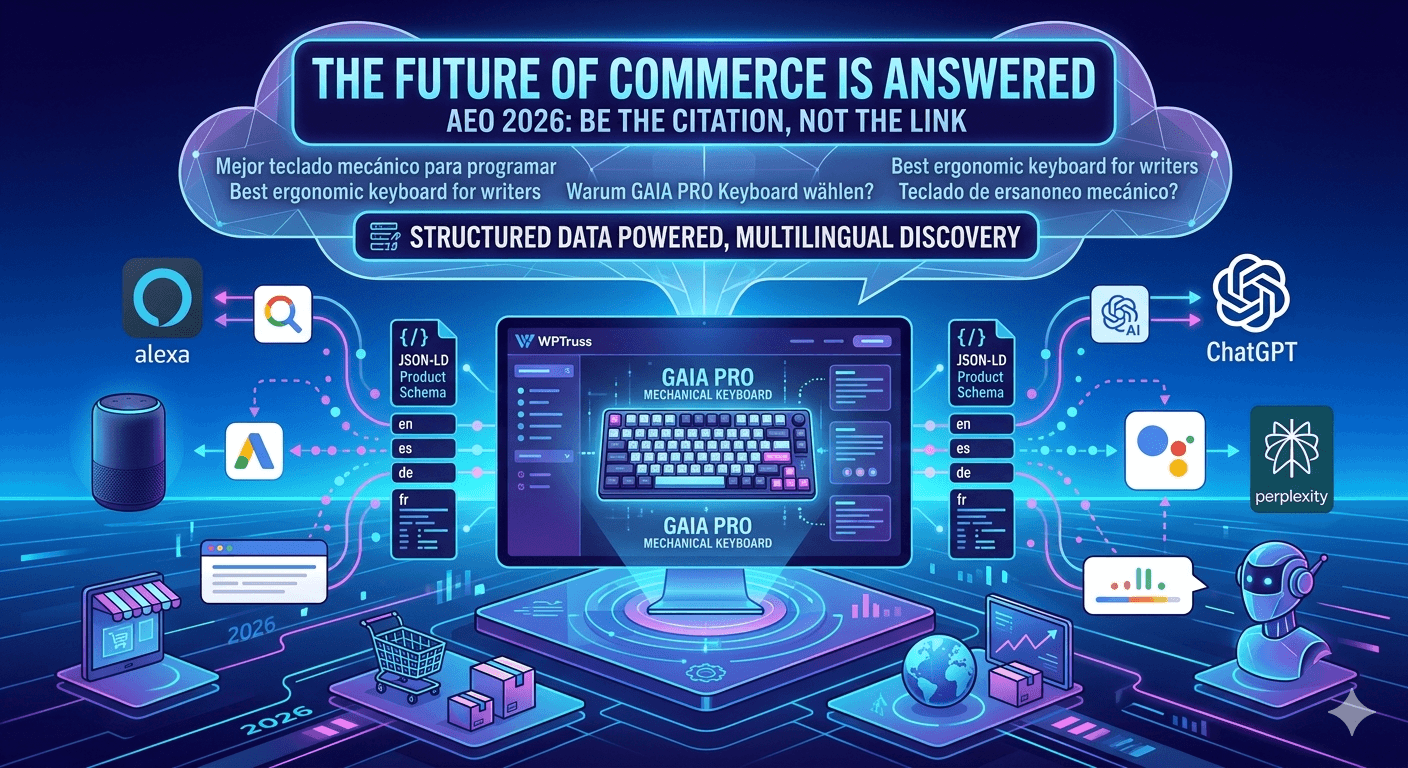
What Is AEO and Why WooCommerce Stores Need It in 2026
There is a new kind of search happening that most WooCommerce store owners have no idea about and it is quietly deciding which products get recommended and which ones get ignored.
When a buyer opens ChatGPT and types “best running shoes for wide feet under €80,” they are not entering a search engine. They are asking a question. The AI reads structured product data across thousands of pages, synthesizes an answer, and cites specific products by name. Your store either appears in that answer or it does not.
This is Answer Engine Optimization (AEO). And for WooCommerce stores selling in 2026, it matters more than almost anything else you could be doing.
What AEO Actually Is
SEO is about ranking. You optimize a page so it appears high in a list of links when someone searches a keyword.
AEO is about being cited. You structure your product data so an AI assistant can read it, understand it, and confidently include your product in a direct answer to a buyer’s question.
The two are completely different disciplines built on completely different signals.
Google ranking depends on backlinks, keyword density, page authority, and on-page optimization. ChatGPT and Perplexity do not care about any of that. They care about whether your product data is structured, specific, complete, and machine-readable.
Specifically, they are looking for:
Productschema: core product identity: name, brand, SKU, price, availabilityalternateNamefields: language-tagged aliases that let AI match your product across multilingual queriesFAQPageschema: structured question-and-answer data that AI assistants can directly citeAggregateRating: review signals that establish trust and specificityBreadcrumbList: category hierarchy that tells AI crawlers where a product sits in your store
If these fields are missing, empty, or poorly structured, AI search engines skip your products entirely — not because your products are bad, but because they cannot parse them confidently enough to cite them.
Why WooCommerce Stores Are Especially Exposed
Here is the uncomfortable reality: WooCommerce does not generate most of this structured data by default.
A standard WooCommerce product page outputs basic HTML. It does not emit alternateName schema. It does not generate FAQPage markup. The Product schema it does produce is minimal, often missing the fields AI engines need most.
The popular SEO plugins Yoast, RankMath, All in One SEO, were built for keyword-era Google. They add Product schema with price and rating data, which was exactly right in 2020. But they were never designed for AEO. None of them generate alternateName fields. None produce FAQPage schema per product.
This means millions of WooCommerce products are invisible to the AI assistants that buyers are increasingly using to make purchasing decisions.
The Multilingual Problem Makes It Worse
AEO becomes dramatically more important if you sell across languages and dramatically harder without the right infrastructure.
Consider a WooCommerce store based in Switzerland, selling in German, French, and Italian. Their product titles are in German. Their schema reflects German text. A French-speaking buyer asks Perplexity for a recommendation. The AI reads the German schema, finds no French-language alternateName, and moves on to a competitor who has structured multilingual data.
The traditional solution, translation plugins like WPML or Weglot, creates duplicate pages at separate URLs. Each language version is a separate entity. Maintaining product data across five languages means five edits every time something changes. At 200 products, that is 1,000 potential edit points. Most store owners give up and run English-only.
AEO solves this differently. Language-tagged alternateName aliases live inside the product schema itself, not on separate pages. One product record. One edit. All languages.
What an AEO-Ready WooCommerce Product Actually Looks Like
Here is the difference between a standard WooCommerce product and an AEO-optimized one.
Standard WooCommerce product schema (simplified):
json
{
  "@type": "Product",
  "name": "Nike Air Zoom Pegasus 40 Men Blue",
  "offers": {
    "price": "79.99",
    "priceCurrency": "EUR"
  }
}
AEO-optimized product schema:
json
{
  "@type": "Product",
  "name": "Nike Air Zoom Pegasus 40 Men Blue",
  "alternateName": [
    { "@value": "Nike Air Zoom Pegasus 40 Herren Blau", "@language": "de" },
    { "@value": "Nike Air Zoom Pegasus 40 Homme Bleu", "@language": "fr" },
    { "@value": "नाइक एयर ज़ूम पेगासस 40 पुरुष नीला", "@language": "hi" },
    { "@value": "Nike Air Zoom Pegasus 40 Purush Neela", "@language": "hi-Latn" }
  ],
  "offers": { "price": "79.99", "priceCurrency": "EUR" },
  "aggregateRating": { "ratingValue": 4.7, "reviewCount": 312 }
}
The second version tells AI assistants: this product exists, it can be found by buyers searching in German, French, or Hindi, and 312 people have reviewed it. That is a citable, trustworthy product. The first one is just a price tag.
The Five Signals AI Search Engines Use to Recommend Products
Understanding what AI assistants actually read helps you prioritize what to fix first.
1. Structured identity. Does the product schema clearly identify what this product is — brand, model, SKU, category? Ambiguous products get skipped.
2. Multilingual reach. Are alternateName fields populated with language-tagged aliases? Without them, your product only exists in one language regardless of how many URLs you have.
3. FAQ coverage. Does the product page answer the questions buyers actually ask — what is it, what is it used for, is it in stock, where can I buy it? FAQPage schema is how AI engines find these answers.
4. Trust signals. Is there an AggregateRating? Are there structured Review entries? Products with no review schema are cited far less frequently than products with clear ratings.
5. Freshness. Is the sitemap updated? Does the schema reflect current pricing and availability? Stale data reduces confidence.
What You Can Do About It This Week
AEO is not a future concern. AI-assisted search already accounts for a significant and growing share of product discovery, particularly among younger buyers and European cross-border shoppers.
The practical starting point:
- Audit your current schema. Use Google’s Rich Results Test or Schema.org Validator on three of your top products. Look for missing
alternateName, emptyFAQPage, and incompleteoffersdata. - Prioritize multilingual
alternateName. If you sell in more than one language — or want to — this is the highest-leverage fix. It requires no duplicate pages and no ongoing maintenance overhead if automated. - Add FAQ schema to your top products. You do not need to do your entire catalog. Start with your ten best-selling products and add structured FAQ data. Even a handful of well-structured FAQs dramatically increases the surface area AI engines have to cite.
- Update your sitemap. AI crawlers rely on sitemaps. Make sure yours is current and includes your most important product pages.
The Honest Take
Traditional SEO is not dead. Google still drives significant traffic, and keyword-based optimization still matters. But it is no longer the only game in town, and for ecommerce product discovery specifically, AEO is already the more important discipline for many store owners.
The stores that invest in structured product data now will have a compounding advantage as AI-assisted search continues to grow. The ones that wait will find themselves invisible to a channel they never prepared for.
WooCommerce makes AEO harder than it should be out of the box. But the infrastructure problem is solvable — and the gap between a standard WooCommerce store and an AEO-ready one is smaller than most people think.
wpTruss builds tools for WooCommerce store owners who want to stay ahead of where search is going. Our plugin GutenLab AI SEO Titles generates AEO-ready multilingual product titles and schema automatically — free on WordPress.org.