
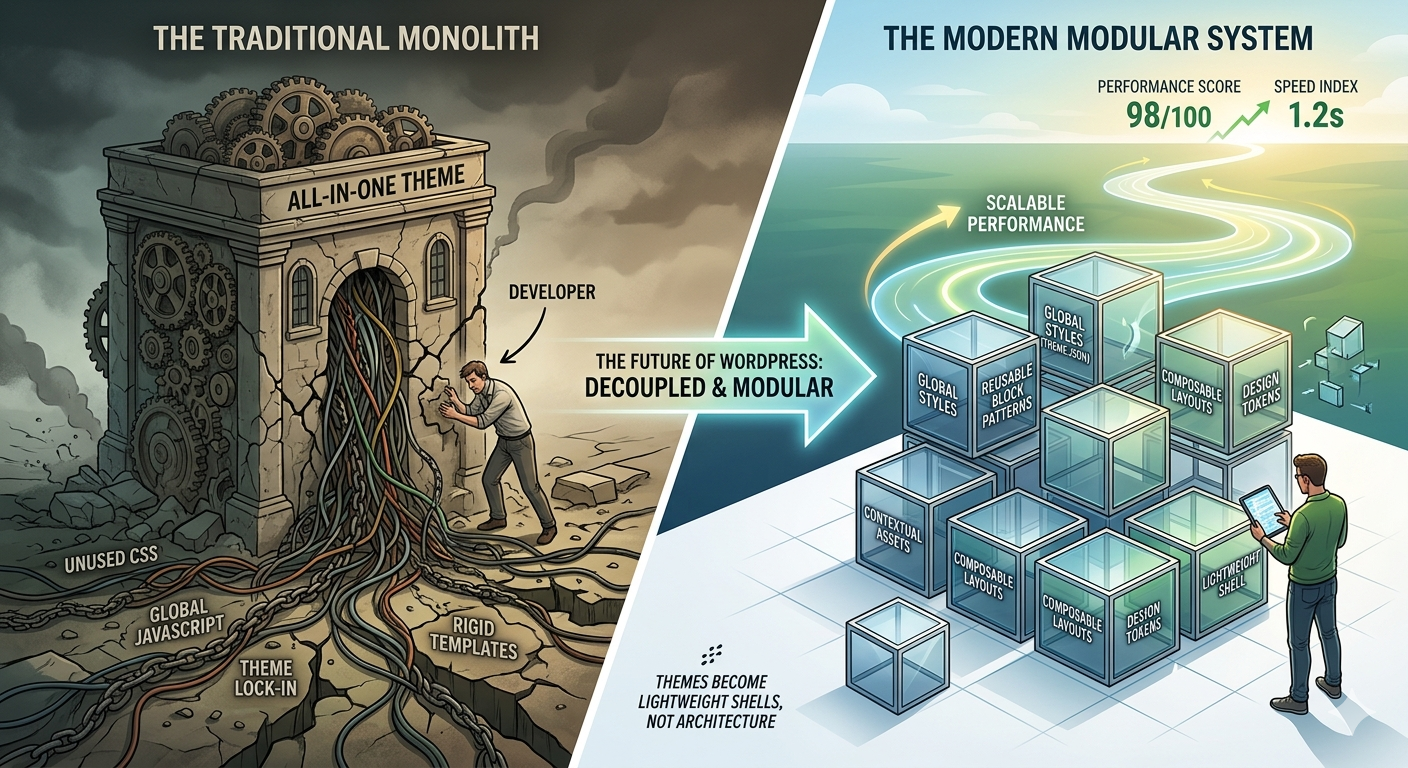
Why Themes No Longer Scale for Modern WordPress Sites
For a long time, WordPress themes were treated as the foundation of a website.
You pick a theme, customize it a little, install some plugins, and the site is ready.
That worked well when websites were mostly:
- blogs
- company websites
- simple landing pages
But modern WordPress websites are much more complex now.
Today a single site can have:
- WooCommerce
- custom post types
- multilingual content
- dynamic filters
- knowledge bases
- funnels
- memberships
- dashboards
- reusable blocks
- performance requirements
- SEO systems
- AI-generated content structures
The problem is… most themes still try to handle everything themselves.
And that’s where the “jack of all trades, master of none” problem starts.
Most themes try to become:
- a design system
- a layout engine
- a plugin compatibility layer
- a WooCommerce framework
- a responsive framework
- a page builder
- an animation system
- a header/footer manager
- a component library
They try to do everything.
And because of that, they slowly become bloated, rigid, and difficult to scale.
1. Themes Are Rigid Structures
Most themes are built around predefined layouts.
They expect your website to follow a certain structure:
- blog layout
- archive layout
- sidebar layout
- product layout
- page layout
The moment your website grows beyond those assumptions, things start getting messy.
Need a completely different structure for:
- products?
- services?
- case studies?
- documentation?
- landing pages?
Now you’re overriding templates, creating child themes, or adding more conditional logic everywhere.
Instead of helping the website grow, the theme starts fighting the website.
2. Themes Usually Ship Huge Amounts of CSS
Most modern themes come with styling for everything:
- sliders
- galleries
- forms
- WooCommerce
- widgets
- animations
- cards
- buttons
- grids
- blog pages
- menus
- builders
- plugins
Even if your website uses only a small portion of it, the CSS still loads.
That means:
- bigger page size
- unused CSS
- harder debugging
- style conflicts
- slower rendering
Over time the CSS becomes difficult to control because everything affects everything else.
3. Unused CSS Gets Loaded on Every Page
This is one of the biggest hidden performance issues in WordPress.
A simple page might still load:
- blog styles
- product styles
- archive styles
- slider styles
- popup styles
- widget styles
- builder styles
…even when those things don’t exist on that page.
Traditional themes are usually global systems.
They load the entire styling framework everywhere.
As the website grows, every page slowly becomes heavier.
4. JavaScript Has the Same Problem
Themes often load JavaScript globally too:
- sliders
- sticky headers
- animations
- counters
- accordions
- menus
- popup systems
- scrolling libraries
Even if the page doesn’t use them.
That creates:
- unnecessary JS execution
- slower interaction speed
- layout shifts
- frontend conflicts
- plugin issues
Eventually the frontend becomes a collection of scripts trying to control the same page.
5. Themes Depend Too Much on Template Hierarchy
Traditional themes rely heavily on WordPress template hierarchy:
single.phparchive.phptaxonomy.phpsingle-product.phpsingle-{cpt}.php
At first this seems fine.
But large websites eventually end up with:
- too many template overrides
- duplicate layouts
- scattered logic
- difficult maintenance
Things become even worse when different content types need different experiences.
6. Theme Updates Can Break Websites
This is still one of the biggest WordPress headaches.
A theme update can:
- change CSS classes
- change layout structure
- break WooCommerce pages
- affect plugins
- override custom changes
- break child theme assumptions
The more customized the site becomes, the riskier updates become.
Many large websites stop updating themes regularly because they are afraid something will break.
That becomes both a maintenance problem and a security problem later.
7. Switching Themes Becomes Almost Impossible
Technically, WordPress themes are supposed to be replaceable.
In reality, most websites become trapped inside their theme.
Why?
Because themes often control:
- layouts
- spacing systems
- styling
- components
- shortcodes
- templates
- menus
- plugin integrations
Changing the theme usually means:
- broken layouts
- broken styling
- rebuilding pages
- fixing spacing everywhere
- cleaning old theme leftovers
At some point, switching themes feels like rebuilding the entire website.
8. Different CPTs Need More Theme Engineering
Suppose your website has:
- products
- blogs
- documentation
- services
- team members
- courses
- portfolios
Each one usually needs:
- different layouts
- different styling
- different structures
- different rendering logic
Traditional themes solve this by adding:
- more templates
- more CSS
- more overrides
- more conditions
Eventually the theme becomes a giant collection of exceptions and patches.
The Bigger Problem
Themes are trying to solve too many things at once.
They are trying to become:
- design systems
- layout systems
- rendering systems
- frontend frameworks
- component libraries
- plugin compatibility systems
That approach doesn’t scale well anymore.
Modern websites need systems that are:
- modular
- reusable
- lightweight
- composable
- flexible
- performance-focused
Not giant monolithic themes controlling everything.
What If Themes Became Disposable?
What if themes became lightweight shells instead of the core architecture?
What if:
- layouts were modular?
- styles loaded only when needed?
- components controlled their own CSS?
- structures were reusable?
- design systems lived independently?
- content types worked independently?
- headers and footers were separate systems?
That would completely change how WordPress websites are built.
A Different Way to Think About WordPress
Imagine a system where:
Themes Become Disposable
The design system does not live inside the theme anymore.
Changing themes no longer destroys:
- spacing
- typography
- component styling
- layout consistency
The website keeps its identity independently.
Structure Becomes Flexible
Instead of forcing everything into predefined templates, pages become composable.
Different sections can behave independently:
- landing pages
- products
- documentation
- blogs
- applications
- funnels
The structure adapts to the content instead of the other way around.
CSS Loads Only When Needed
Instead of loading a giant global framework:
- components load their own styles
- unused CSS disappears
- pages stay lighter
- debugging becomes easier
Frontend performance scales much better.
JavaScript Becomes Contextual
Only interactive components load JavaScript.
No need to load:
- sliders
- animations
- accordions
- popup systems
…on pages that don’t use them.
This keeps the frontend cleaner and faster.
Design Consistency Comes From Shared Tokens
Instead of hardcoding styles everywhere, components share common design variables:
- colors
- spacing
- typography
- shadows
- radii
- container widths
Changing the design system updates the whole website consistently.
Content Types Become Independent
A product system should not interfere with:
- documentation
- blogs
- services
- courses
- portfolios
Each system can evolve independently while still sharing the same design language.
WordPress Is Already Moving in This Direction
Gutenberg changed how WordPress works.
The future of WordPress is clearly moving toward:
- reusable systems
- modular structures
- block-based architecture
- composable layouts
- shared design systems
Not giant all-in-one themes.
Themes made sense when websites were smaller and simpler.
But modern WordPress websites behave more like applications now.
And applications don’t scale well when the entire frontend architecture is trapped inside one giant rigid theme.
The future probably isn’t “better themes.”
It’s smaller, modular systems where themes become lightweight, replaceable shells instead of permanent architectural dependencies.
Have you ever avoided updating a theme because you were afraid something might break?
Have you ever opened a theme folder and wondered why a simple website needs thousands of lines of CSS and JS?